





Page Navigation


Select a different country or region to view content tailored to your location.


Chris Cammack is the Partner Manager and a financial writer at FxScouts. Chris builds and maintains our relationships with our partners to provide our users with the best Forex trading experience.


Sentiment analysis is key to understanding why price moves the way it does, as the market price is determined by how traders position themselves in the market. This market sentiment explains the irrational behaviour of the market and how investors' psychology impacts currency exchange rates.
Whenever you open a trade, you are making a financial commitment. In doing so, you express a view of what you feel the market will do. Overall, market sentiment is derived from the combined perspective of every market participant's opinions, trades, and ideas. The combined market position is what we can define as market sentiment.
Traders can use this comprehensive view of the market to analyze it. Technical indicators offer retail traders a picture of all the orders and positions currently open with the broker.
Technical tools can help you gauge market sentiment. The typical sentiment indicator shows the percentage of traders who are long versus short.
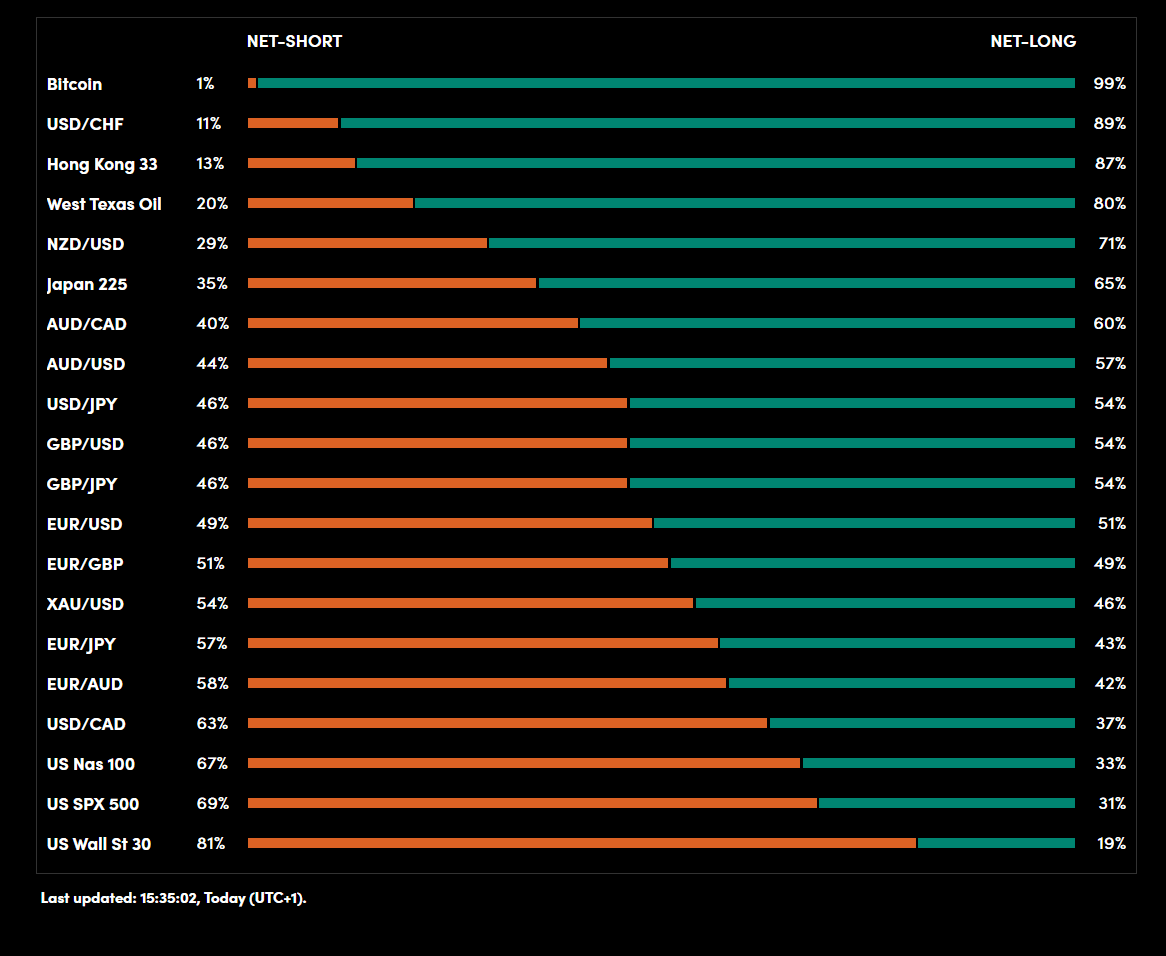
Below is a summary of all retail traders' open positions at Oanda. It shows that 89% of the client orders on the USD/CHF (United States Dollar to Swiss Franc) are long. This means that 89% of the participants placing orders think that the price of the Dollar will rise against the Franc.
Sentiment analysis can help you spot contrarian trading opportunities. A contrarian trading strategy trades against the current market trend and centres around looking for points where a trend is likely to reverse.
Contrarian trading is far from risk-free. When trading against a particularly strong trend, the market can sometimes continue to trade in the same direction longer than you can stay solvent. This is why it’s essential only to trade those particular instances when you have excellent information to support your conclusion on future market movements.
It’s recommended only to trade those instances when the market sentiment reaches extreme levels of more than 70%. You may consider fading the market or trading against the trend in this case.

From the first OANDA sentiment analysis chart above, the EUR/AUD satisfies the condition that almost 75% of retail traders are short on this market. The next step is to look for significant support and resistance levels to time the market. The sentiment analysis tool only gives you the state of the current market, which is why you need to use it in combination with other supportive technical analysis tools.
Successful contrarian traders try to minimise their losses and maximise their profits. Two key steps can help you achieve this:
Incorporating sentiment analysis into your trading can give your strategy a competitive edge. It can also help you quickly identify new trading opportunities that few others are aware of.
Smart traders wait for sentiment to reach extremes and for significant and reliable data before engaging the market. Once all the trade setup conditions are made, be patient and wait for the market to confirm your analysis before entering.
The main idea behind sentiment analysis is that you don't have to know the exact probability of a trade. All you need to know is if sentiment will be better or worse in the future and base your trades on that assumption.
Explore more resources that fellow traders find helpful! Check out these other guides to enhance your forex trading knowledge and skills. Whether you’re searching for the best brokers, educational material, or something more specific, we’ve got you covered:

Discover how Forex Trading works with our essential guide. Understand key terminology with examples and learn how to make your first successful trade.

We’ve tested hundreds of Forex brokers to find the safest, low-cost, and reliable brokers. Compare fees, and features—trade smarter with expert insights!

Explore the best Forex brokers for beginners, with user-friendly platforms, educational resources, and demo accounts.
Partner Manager and Financial Writer
Head of Content
Financial Writer