





- Find the best broker for your trading needs
- Compare spreads, fees, and platforms
- Read in-depth reviews and analysis
Page Navigation


Select a different country or region to view content tailored to your location.

FxScouts helps traders across the globe by meticulously testing and reviewing online brokers and providing Forex education and market analysis. Our partners compensate us through paid advertising. While partners may pay to provide offers or be featured, they cannot pay to alter our recommendations, advice, ratings, or any other content. Our content and research teams do not participate in any advertising planning nor are they permitted access to advertising campaign data. For more information, click here.

Alison Heyerdahl is the Head of Content at FxScouts, a Chartered Market Technician (CMT), and an experienced trader, as well as a financial writer with extensive expertise in Forex trading, broker analysis, and market research. She has reviewed 100+ brokers, publishes weekly YouTube trading videos, and co-hosts the “Let’s Talk Forex” podcast.

Alison Heyerdahl is the Head of Content at FxScouts, a Chartered Market Technician (CMT), and an experienced trader, as well as a financial writer with extensive expertise in Forex trading, broker analysis, and market research. She has reviewed 100+ brokers, publishes weekly YouTube trading videos, and co-hosts the “Let’s Talk Forex” podcast.
Chris Cammack is the Partner Manager and a financial writer at FxScouts. Chris builds and maintains our relationships with our partners to provide our users with the best Forex trading experience.
The stock market remains one of the most exciting and liquid financial markets in the world. Trading Contracts for Difference (CFDs) on stocks provides a way to speculate on the price movements of both local and global companies—without needing to purchase the stocks outright. CFDs are often classified as high-risk derivative instruments, which means traders must carefully manage risk—but when used properly, they can be a powerful way to participate in the stock market.
Stock CFD trading gives traders:
Trusted. Transparent. Tested.
For over a decade, we’ve set the standard in forex broker reviews—collecting thousands of data points yearly to deliver unbiased, expert-backed insights.
Skip the trial and error! Below, you’ll find the best forex brokers for 2026—thoroughly tested, verified, and ranked, so you can trade with confidence.

Swipe to scroll
Broker | Official Site | Equities | Regulated By | Website Language: English | Support Language: English | Compare | ||||
|---|---|---|---|---|---|---|---|---|---|---|
 | No | 0 | 26137 | USD 0 |   | Yes | Yes | |||
 | Yes | 13000 | 19295 | USD 0 |        | Yes | Yes | |||
 | Yes | 10000 | 10162 | USD 100 |    | Yes | Yes | |||
 | Yes | 2090 | 2241 | USD 100 |   | Yes | Yes | |||
 | Yes | 1600 | 1744 | USD 200 | | Yes | Yes | |||
 | Yes | 636 | 930 | USD 100 |    | Yes | Yes | |||
 | Yes | 1300 | 1597 | USD 0 | | Yes | Yes | |||
 | Yes | 257 | 498 | USD 100 |  | Yes | Yes | |||
 | Yes | 2177 | 8658 | USD 0 |   | Yes | Yes | |||
 | Yes | 10500 | 12146 | USD 5 |  | Yes | Yes |










Select another broker to another broker to compare features, fees, and platforms side by side.
Find Your Ideal Forex Broker
Select another broker to another broker to compare features, fees, and platforms side by side.
0.1 pips
FMA, FSA-Seychelles
USD 0
TradingView, MT4, cTrader, MT5
500:1
BlackBull Markets provides access to a huge range of stock CFDs across the US, UK, EU, and Asia—available through both MT5 and the dedicated BlackBull Shares platform.
Trade major U.S. stocks like Apple, Tesla, and Amazon with zero commission and tight spreads—ideal for short-term traders and swing traders.
All trades are routed through BlackBull’s ECN infrastructure—providing direct market access and fast execution without broker interference.
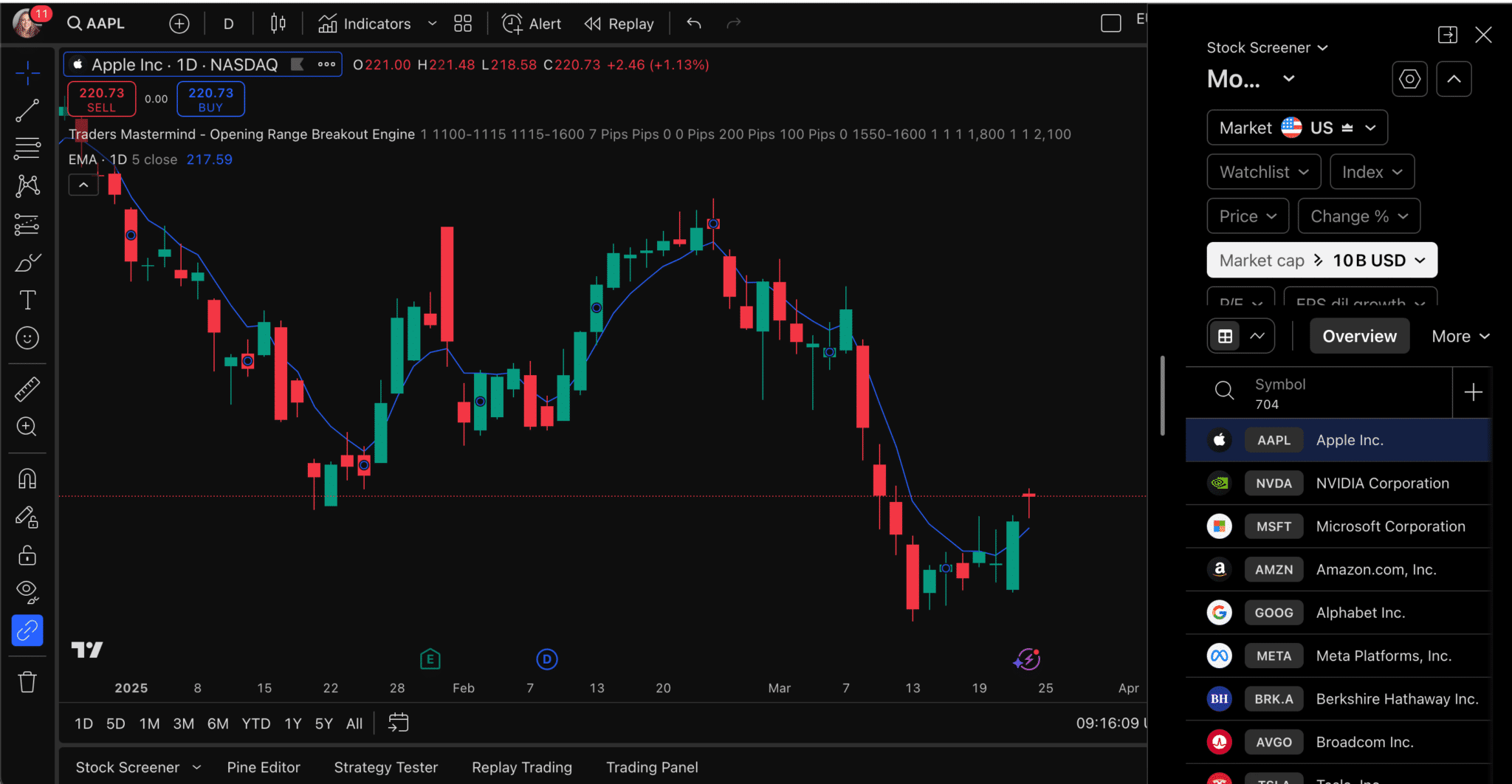
Stock CFDs are available on MT5 with full support for indicators and EAs, or through BlackBull’s web-based stock trading platform for more visual, portfolio-style management.
Use TradingView for stock analysis, FIX API for custom strategy execution, and VPS hosting for 24/5 uptime on automated stock CFD strategies.
Non-US traders can still fund their accounts, but will have to pay currency conversion costs.
Select another broker to another broker to compare features, fees, and platforms side by side.
0.6 pips
BMA, CFTC, FINMA, FMA, BaFin, DFSA, FSA-Japan, MAS, ASIC, FSCA, FCA
USD 0
TradingView, L2 Dealer, MT4
200:1
IG offers one of the broadest selections in the business, covering LSE, NYSE, Nasdaq, and European exchanges.
Professional traders can place share CFD orders directly into the underlying order book via L2 Dealer.
Access to out-of-hours trading, weekend UK100, and IG Smart Portfolios (CFD-based ETFs) unavailable elsewhere.
IG’s ProRealTime charts, market screeners, and earnings calendars cater directly to share traders.
Expect to post 20–25% margin vs. 5–10% at rivals like Pepperstone or Markets.com.
Advanced CFD traders relying on MT5’s depth may find this limiting.

IG | Best For: Advanced share CFD traders & multi-market strategies
FxScouts
 YouTube
Select another broker to another broker to compare features, fees, and platforms side by side.
0.0 pips
CMA, FSA-Seychelles, FSC, ASIC, FSCA
USD 100
TradingView, MT4, cTrader, MT5
500:1
FP Markets is one of the few brokers offering true DMA access to thousands of global equities, including NYSE and NASDAQ.
cTrader provides Level 2 pricing, TradingView provides excellent charting and MT5 provides depth of market analysis.
Ultra-low commissions starting from AUD 10 and no hidden markups make FP Markets attractive for high-frequency stock CFD traders.
To access stock CFDs via IRESS, traders need to reside in Australia
FP Markets | Best For: Traders looking for low-latency ECN execution on stock CFDs
FxScouts
YouTube
Select another broker to another broker to compare features, fees, and platforms side by side.
0.4 pips
SCB, DFSA, FCA, CySEC, FSCA
USD 100
FxProEdge, MT5, cTrader, MT4
Unlimited:1
FCA and CySEC regulated with a clean track record accessible support
MT4, MT5, cTrader, and FxPro Edge – versatile for any strategy
Negative balance protection + guaranteed stop losses on Share CFDs
Tight spreads even during volatile US market opens
Not ECN – spread-based model may not appeal to pro scalpers
Less beginner content compared to FP Markets or FBS

FxPro | Best For: Share CFD traders seeking a balance of trust, platform choice, and market access
FxScouts
YouTube
Select another broker to another broker to compare features, fees, and platforms side by side.
0.1 pips
CMA, FSA-Seychelles, ASIC, CySEC
USD 200
TradingView, MT4, cTrader, MT5
1000:1
Trade US, EU & Australian shares with leverage.
IC Markets uses NY4 & LD5 Equinix servers for ultra-fast fills.
True ECN pricing from top-tier liquidity providers.
No restrictions for active strategies
No stock access via MT4 or cTrader.
IC Markets | Best For: Active stock CFD traders, day traders, algo & EA users
FxScouts
YouTube
Select another broker to another broker to compare features, fees, and platforms side by side.


Stock CFDs let you speculate on stock price movements without owning the stocks. They offer global market access, lower entry costs, and flexibility but carry higher risks due to leverage.
Stocks are ownership stakes in a company. For example, if you buy stocks on an exchange like Nasdaq, you own part of the company, may receive dividends, and get stockholder rights.
By contrast, a stock CFD is a contract between you and a broker. You do not own the underlying stock—you speculate on its price changes. This distinction makes CFDs:
For many traders, trading physical stocks through an exchange can be costly due to brokerage commissions, settlement delays, and higher capital requirements. Stock CFDs offer:
With leverage, you can control 10,000 USD worth of stock CFDs with only 500–1,000 USD. This allows traders with smaller accounts to participate in global markets. Example: With 20:1 leverage, a 2,000 USD margin gives exposure to 40,000 USD worth of stocks.
CFDs allow you to go short (sell) when expecting a decline easily. This is particularly useful in volatile markets.
Many brokers offer thousands of international stocks, including those listed on the S&P 500 and FTSE.
No settlement delays (CFDs trade instantly), tighter spreads, and no stamp duty compared to physical stock ownership
Well-regulated brokers such as IG provide free demo accounts where you can practise trading without risking capital.
A 5% adverse move on a leveraged position can wipe out your margin completely. For beginners, overuse of leverage is the most common reason for blowing accounts.
Holding CFDs overnight incurs interest (e.g., 2–3% above benchmark rates). These can eat into profits for swing traders.
You do not own the underlying stock, so you miss out on stockholder benefits, though brokers sometimes adjust for dividends.
Stock markets, especially emerging market equities, are prone to gapping—sudden large price moves that can trigger stop-loss orders at worse-than-expected levels.
According to BrokerChooser, up to 70–80% of retail CFD traders lose money. Beginners must be cautious and well-prepared.
Costs vary widely depending on the broker but typically include:
The difference between buy and sell prices. For liquid stocks like Apple, spreads can be as low as 0.1%. For smaller stocks, spreads may be wider.
Many brokers charge ~0.1% commission per trade (per side) on stock CFDs.
Example: A 100,000 USD trade might cost 100 USD to enter and 100 USD to exit.
If you hold a position overnight, you’ll pay an interest fee. For long positions, this can be 2–3% above the interbank rate.
Some brokers charge 10 USD/month if no trades occur within 12 months.
If you deposit in another currency than you trade with, brokers may charge a currency conversion fee.


Find clear answers to the most common questions about trading stock CFDs, from costs and dividends to leverage, and risk.
No—you don’t own the underlying share, so you won’t receive dividends directly.
Leverage depends on regulation, the broker and the stock’s volatility:
While attractive, leverage magnifies losses as much as gains—new traders should start conservatively.
Costs are higher for stock CFDs than for forex pairs because of commissions:
Yes—that’s one of the most significant advantages of stock CFD trading. You can profit when a company’s stock price falls by opening a short position.
Example:
Most brokers typically require deposits of around 100–250 USD, but sometimes as low as 5 USD.
Yes, because of leverage and financing costs. Real share ownership is unleveraged: a 5% drop means you lose 5%. With 10:1 leverage on CFDs, that same 5% drop wipes out 50% of your margin. Additionally, holding shares long-term may generate dividends; CFDs are best suited for short-term speculation.
Beginners should avoid overtrading and focus on one or two familiar stocks to understand how they react to news and earnings.
Explore more resources that fellow traders find helpful! Check out these other guides to enhance your forex trading knowledge and skills. Whether you’re searching for the best brokers, educational material, or something more specific, we’ve got you covered:

Discover how Forex Trading works with our essential guide. Understand key terminology with examples and learn how to make your first successful trade.

We’ve tested hundreds of Forex brokers to find the safest, low-cost, and reliable brokers. Compare fees, and features—trade smarter with expert insights!

Explore the best Forex brokers for beginners, with user-friendly platforms, educational resources, and demo accounts.
60-90% of retail traders lose money trading Forex and CFDs. You should consider whether you understand how CFDs and leveraged trading work and if you can afford the high risk of losing your money. We may receive compensation when you click on links to products we review. Please read our advertising disclosure. By using this website, you agree to our Terms of Service.
Partner Manager and Financial Writer
Head of Content
Financial Writer




Welcome to the FxScouts community! We’re thrilled to have you on board. You’ve successfully signed up for our forex newsletter, where you’ll receive expert insights, market analysis, and the latest news straight to your inbox.
Get ready to stay ahead of the curve with our regular updates designed to help you make informed trading decisions.
Happy trading!
The FxScouts Team