- Find the best Forex Trading App for your needs
- Compare spreads, fees, and platforms
- Read in-depth reviews and analysis
FxScouts helps traders across the globe by meticulously testing and reviewing online brokers and providing Forex education and market analysis. Our partners compensate us through paid advertising. While partners may pay to provide offers or be featured, they cannot pay to alter our recommendations, advice, ratings, or any other content. Our content and research teams do not participate in any advertising planning nor are they permitted access to advertising campaign data. For more information, click here.
Choosing the best forex trading app should be easy. Unfortunately, as I and many other traders have discovered, reality is not so simple.
A forex trading app is not just an app. It is a trading platform, a broker connection, a charting tool, an account management system, and sometimes, a very efficient way to make bad decisions faster than you would on a desktop computer.
The best app for a beginner who wants a clean mobile experience is not the same as the best app for a scalper, a copy trader, or someone running automated strategies.
Trusted. Transparent. Tested.
For over a decade, we’ve set the standard in forex broker reviews—collecting thousands of data points yearly to deliver unbiased, expert-backed insights.
Skip the trial and error! Below, you’ll find the best forex brokers for 2026—thoroughly tested, verified, and ranked, so you can trade with confidence.
Brokers regulated by top-tier global authorities such as ASIC, the FCA, and CySEC are more secure. These are some of the world’s strictest Forex trading regulators, ensuring a fair and transparent trading environment. Choosing a well-regulated broker offers key protections:
Swipe to scroll
Name | Ease of use How easy is the app to learn and use | App Type Third party apps are available at multilple brokers | Supported Brokers Which brokers offer this app | Stability Score We measure how often an app lags, crashes or freezes. | App Store Score | Google Play Score | Copy Trading | Advanced Charting | Automation Support | |
|---|---|---|---|---|---|---|---|---|---|---|
| Avatrade App | ![]() | Intuituve but basic | Broker owned | 4 | 4.30 | 4.10 | No | No | No | |
| TradingView App | ![]() | Best in class for charting | Third Party | 5 | 4.80 | 4.70 | Yes | Yes | Yes | |
| cTrader App | ![]() | Modern and powerful | Third Party | 5 | 4.80 | 4.70 | Yes | Yes | Yes | |
| MT5 App | ![]() | Advanced but Cluttered | Third Party | 5 | 4.80 | 4.80 | Yes | Yes | Yes | |
| xStation App | ![]() | Easy to use with excellent charting | Broker owned | 4 | 4.70 | 4.50 | No | Yes | No | |
| Exness Trade App | ![]() | Beginner-friendly and stable | Broker owned | 4 | 4.70 | 4.60 | No | No | No | |
| MT4 App | ![]() | Complex and Dated | Third Party | 5 | 4.80 | 4.60 | Yes | No | Yes | |
| XM App | ![]() | Modern but lacking advanced functionality | Broker owned | 3 | 4.80 | 4.30 | Yes | No | Yes | |
| Pepperstone App | ![]() | Easy-to-use but unstable | Broker owned | 3 | 3.40 | 4.20 | No | No | No | |
| HFM App | ![]() | Integrated education and copy trading | Broker owned | 4 | 3.40 | 4.10 | Yes | No | No |
Find Your Ideal Forex Broker
4.0
4.30
4.10
No
Intuituve but basic
The AvaTrade app combines live pricing, basic charting, and one-tap order execution.
AvaProtect lets traders shield positions from losses for a chosen period.
Access 1,000+ instruments — forex, indices, stocks, commodities, and crypto — from one app.
Trade fluidly between mobile, WebTrader, and desktop without losing data.
Set custom price alerts and receive instant updates on key market movements.
Mobile charting tools are lighter than full desktop MT4/MT5 setups.
Leverage and product range differ depending on local regulation.
While more stable than most trading apps, log-outs and crashes can occur
5.0
4.80
4.70
Yes
Best in class for charting
TradingView is strongest as a charting and analysis app. Its clean interface, drawing tools, indicators, watchlists, and multi-device syncing make it a very strong choice for traders who spend more time analysing markets than simply placing orders. Charts and analysis started on desktop are also available on mobile, which makes it useful for traders who move between devices.
Traders can set alerts around price levels, indicators, and custom conditions, then receive notifications on mobile, desktop, email, or webhook. For traders who do not want to stare at charts all day, this is a serious advantage.
TradingView covers far more than forex. Traders can follow currencies, indices, commodities, shares, and cryptocurrencies from the same interface. This makes it particularly useful for traders who want to understand broader market context.
TradingView allows users to trade directly through integrated brokers, which means some traders can analyse and execute from the same platform. Broker support is not universal, so traders should check whether their preferred broker is connected first.
TradingView also offers paper trading, allowing traders to practise buying and selling without risking real money. This is useful for testing ideas, learning the platform, or checking whether a strategy makes sense before adding the emotional complication of actual capital.
TradingView is excellent for analysis, but it is not always the place where trades are executed. Many traders still use TradingView for charts and then place orders through MT4, MT5, cTrader, or a broker app. This is not a deal-breaker, but it does mean TradingView is often part of a workflow rather than the whole trading setup.
TradingView can be used for free, but serious users may run into limits around alerts, indicators, layouts, and data. For traders who rely heavily on charting, the paid plans may become less of a luxury and more of an operating cost.
5.0
4.80
4.70
Yes
Modern and powerful
cTrader feels more modern than MT4 and MT5, which makes it easier to navigate for beginners. The layout is cleaner, order tickets are clearer, and the platform feels less like it was designed by engineers for other engineers. For traders who find MetaTrader intimidating, this is a real advantage.
cTrader is not just a beginner platform. It offers advanced charting, multiple order types, market depth, and useful execution tools, making it suitable for traders who want more control. It is approachable enough for newer traders, but not so basic that experienced traders will outgrow it.
cTrader supports algorithmic trading through cTrader Automate, with strategies and indicators built using C#. More recently, Python support has also made it more attractive to traders who want to test, build, and automate trading ideas without relying on the MetaTrader ecosystem.
cTrader is often associated with ECN-style trading, transparent pricing, and fast order execution. This makes it appealing for scalpers and active traders, especially when paired with a broker offering tight spreads and low commissions.
For many traders, cTrader’s biggest strength is simply that it feels easier to use. Charting is clean, watchlists are intuitive, and the platform does not have the same dated feel as MT4.
The biggest weakness of cTrader is availability. MT4 and MT5 are offered by a much wider range of brokers, while cTrader support is more limited. This means traders may have fewer broker choices if they decide cTrader is their preferred platform.
cTrader supports automation, but its ecosystem is smaller than MetaTrader’s. Traders looking for ready-made bots, indicators, scripts, and community tools will usually find more options on MT4 and MT5. If you want the largest third-party library, MetaTrader still has the advantage.
5.0
4.80
4.80
Yes
Advanced but Cluttered
MT5 is the more modern version of MetaTrader and is generally the better all-round platform for traders who want more than forex trading. It supports more asset classes, more order types, more timeframes, and a more flexible trading environment than MT4.
The MT5 app gives traders access to charts, watchlists, indicators, open positions, account history, and order management from a phone or tablet. It is not as clean as some proprietary broker apps, but it is much more capable. A useful companion to the desktop platform.
MT5 offers more order types than MT4 and includes market depth, which is useful for traders who want more control over entries and exits. This makes it particularly attractive to active traders, scalpers, and those who want a more detailed view of market liquidity.
MT4 was built around forex. MT5 is better suited to traders who want to trade multiple CFD markets from the same account. If you trade forex alongside indices, commodities, shares, or crypto CFDs, MT5 is usually a better fit.
Like MT4, MT5 supports automated trading, custom indicators, scripts, and Expert Advisors. Its ecosystem is not quite the same as MT4’s legacy library, but it is larger than cTrader's and continues to grow.
MT5 is powerful, but not always gentle. The mobile app includes plenty of tools, menus, charts, and order options, which can feel overwhelming for newer traders. Beginners who mainly want a simple way to place trades and check their account may find a broker-owned app easier to use.
The MT5 mobile app is useful, but it is not a full replacement for the desktop platform. Detailed chart work, automated trading, multi-chart layouts, and more complex strategy testing are still better handled on desktop.
4.0
4.70
4.50
No
Easy to use with excellent charting
xStation is XTB’s proprietary trading app, and its biggest strength is that it feels like it was designed for ordinary humans. The layout is cleaner than MetaTrader, navigation is more intuitive, and the app does a good job of making trading tools accessible without burying users under menus.
The xStation app gives traders access to charts, watchlists, price alerts, technical indicators, order management, and account information. It is particularly useful for traders who want to monitor markets, manage positions, and react to price alerts without a desktop platform.
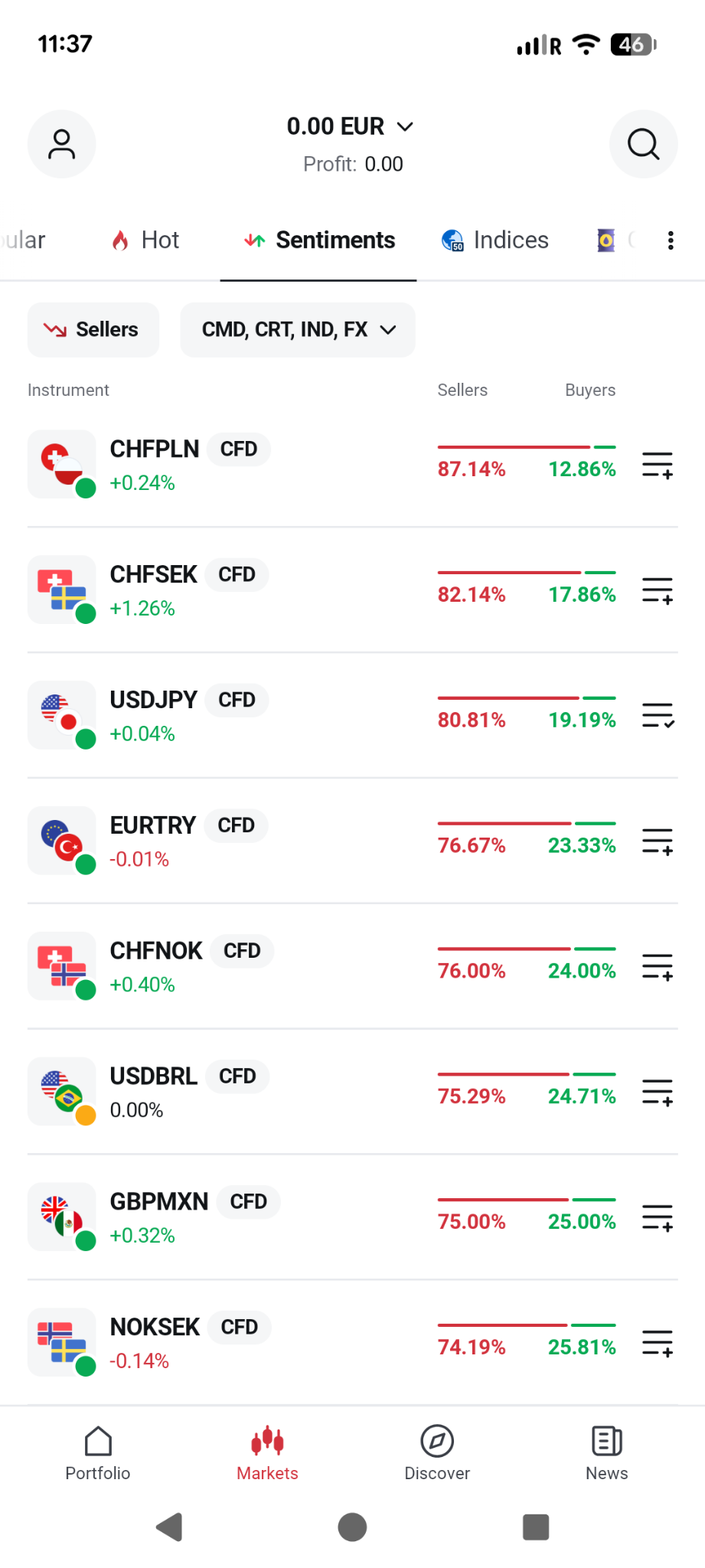
Traders can access market commentary, economic calendar data, sentiment tools, and analysis features without needing to jump between several different platforms. xStation is not as deep as TradingView for charting, but it is much more convenient as an all-in-one trading environment.
xStation is not only for forex. Through XTB, traders can access a broad range of markets including forex, indices, commodities, shares, ETFs, and CFDs from the same platform. This makes it useful for traders who want one app for several markets rather than separate tools for every asset class.
Because xStation is built by XTB, the app is not just a trading terminal. It also handles account management, deposits, withdrawals, portfolio information, and platform settings in one place.
The biggest limitation of xStation is that it is tied to XTB. Unlike MT4, MT5, TradingView, or cTrader, you cannot take the platform with you if you move to another broker. If you like switching brokers or comparing execution across several accounts, this lack of portability matters.
xStation is polished and convenient, but it is not the obvious choice for traders who rely on Expert Advisors, custom bots, or a large third-party automation ecosystem. Traders who want serious algorithmic trading will usually be better served by MT4, MT5, or cTrader.
One of the biggest mistakes traders make is choosing a broker first and only then discovering that the app does not fit the way they trade. It is better to think about what you want from an app first and then choose a broker that supports it.
I have found that most trading app comparisons are usually too vague. They list features like “real-time data” and “advanced charting tools”, which sounds useful until you realise almost every app says the same thing. A true comparison should ask what type of trader each app is good for and what the user experience is like.
| Platform | Best for | Strengths | Limitations |
|---|---|---|---|
| MT4 | Algo traders and legacy users | Huge EA library, widely supported | Outdated interface, limited mobile functionality |
| MT5 | Most active traders | Better tools, more order types, multi-asset support | More complex for beginners |
| TradingView | Charting and analysis | Excellent charts, clean interface, strong alerts | Not all brokers support direct execution |
| cTrader | Beginners and programmatic traders | Modern interface is easy for beginners, Algos can be written in Python and C# | Not supported by many brokers, small EA library |
| Proprietary broker apps | Beginners and mobile-first traders | Simple, easy to use, good account management | Weaker charting and limited automation |
MT4 is old, familiar, and still everywhere. Traders continue to use it because it has a huge library of EAs and indicators and is available through many brokers.
Its weakness is also obvious. It looks and feels dated, and the mobile version is much more limited than the desktop platform. If you want automated forex trading, MT4 still has a place. If you want the cleanest mobile experience, it probably will not be your first choice.
MT5 is the most popular platform and is the most widely available. It supports more asset classes, more order types, better market depth, and has a more flexible trading environment than MT4.
But MT5 mobile can feel crowded. It is powerful, but not easy to pick up. For beginners, the learning curve can be steeper than with a simplified broker app. For intermediate and advanced traders, that extra complexity is often worth it.
TradingView is best understood as a charting and analysis platform first. It is excellent for traders who care about clean charts, drawing tools, indicators, alerts, and multi-device analysis.
The catch is execution. Some brokers integrate with TradingView, but many traders still use it mainly for analysis and place trades elsewhere. This is not necessarily a problem. In fact, for many traders, separating analysis from execution can be a good thing.
My personal favourite, cTrader has both the simplicity of a modern broker app and the depth of MetaTrader. Its interface is cleaner and more intuitive than MT4 or MT5, which makes it less intimidating for beginners, but it also has serious appeal for more technical traders.
Its main strength is programmability. Traders can build automated strategies using Python and C#, which makes it attractive for those who want more control than a standard mobile app can offer. The problem is availability. cTrader is not supported by as many brokers as MetaTrader, and its library of ready-made bots and indicators is much smaller. If you want a modern platform with automation potential, it is worth considering. If you want the biggest ecosystem, MetaTrader still has the advantage.
Broker-owned apps are usually designed for simplicity. They often make deposits, withdrawals, watchlists, account management, and basic trading easier than MetaTrader or cTrader.
That simplicity comes with trade-offs. Proprietary apps often have weaker charting, fewer custom indicators, limited automation, and less flexibility. They are usually best for beginners, casual traders, and mobile-first users rather than advanced technical traders.
A good trading app should make it easy to move from analysis to action without creating unnecessary friction. Charts should load quickly. Order tickets should be clear. It should be obvious whether you are placing a market order, a pending order, or adjusting a stop loss. Your open positions, margin, balance, and exposure should be visible without needing to dig through menus.
But different apps are best suited to different traders. For instance, the best app for beginners is one that removes clutter and has clear signposting. But after trading for a few years, I found that the best app for me is the one that gives me more control, even if it takes longer to learn.
Beginners should not start with a powerful trading app simply because experienced traders use it. A beginner-friendly app should make the basics easy: opening a demo account, finding major currency pairs, placing a trade, setting a stop loss, checking margin, and understanding account balance.
| Beginner priority | Why it matters |
|---|---|
| Simple navigation | Reduces confusion |
| Demo account | Allows practice without risking money |
| Clear order tickets | Helps prevent costly mistakes |
| Easy stop-loss placement | Supports basic risk management |
| Education | Helps users understand what they are doing |
| Strong regulation | Protects users from unnecessary broker risk |
The goal is not to find the app with the most features. It is to find the app least likely to confuse you at the exact moment you are about to risk money.
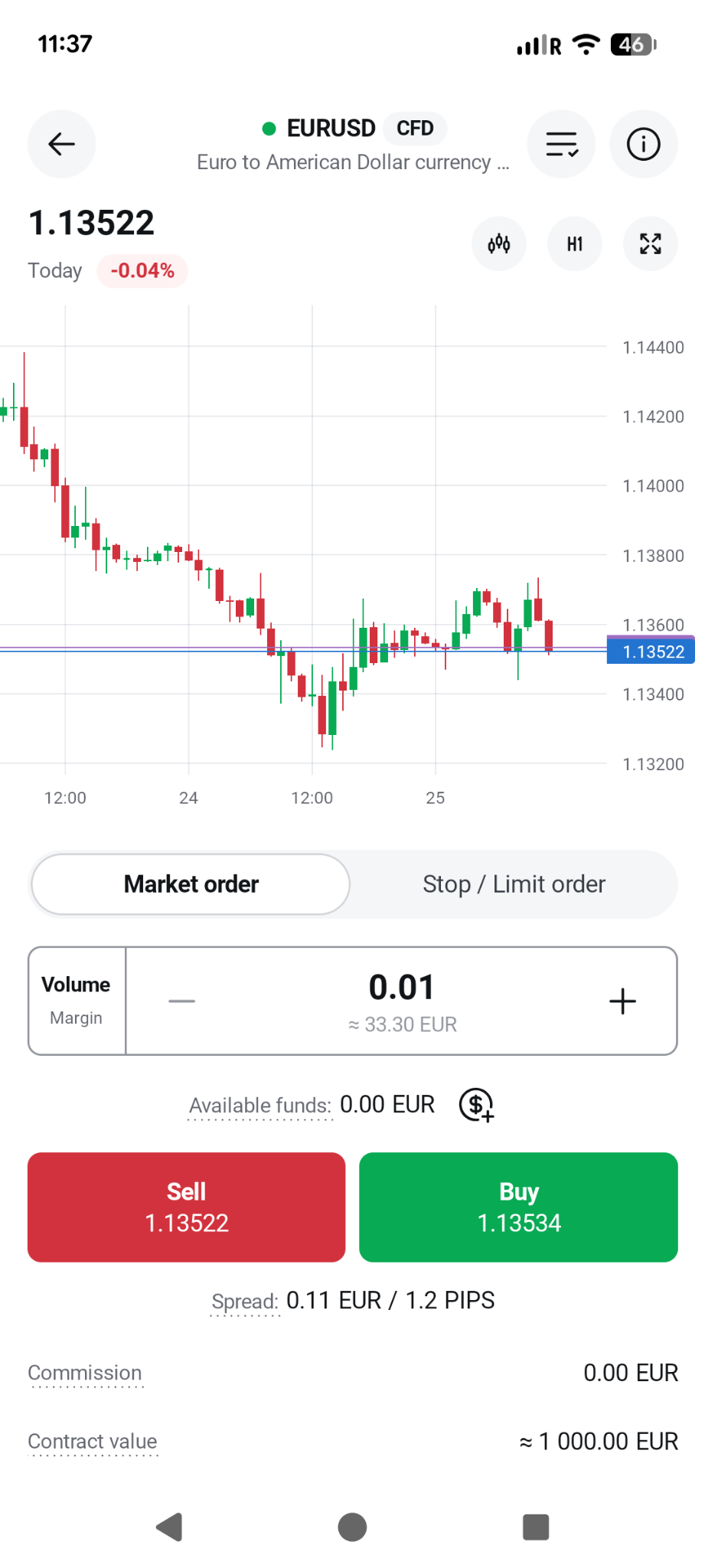
My favourite app for beginners is the AvaTrade app. I find it easy to use, with useful built-in tools like AvaProtect, a spread calculator, education, and a trend viewer. The chat is generally responsive, which made basic support questions easy to handle.
That said, the app still has some frustrating limitations. I was logged out frequently, the platform sometimes lagged, and the charting tools are limited compared to more advanced trading apps. Sometimes, dark mode seemed to be permanently enabled, which was annoying. Customer support was fine for simple issues, but slower when dealing with more serious problems.
Overall, the AvaTrade app is a good choice for beginners who want a simple, accessible trading experience with helpful tools built in. Though traders may find the limited indicators, charting options, and occasional lag annoying.
Before we go any further, it’s important to say that you really should not be scalping on your phone or any mobile device, the potential for lag on mobile devices is a killer for scalpers. But if you absolutely have to, then you really should be using cTrader.
I found Pepperstone’s cTrader app well suited to scalping because the platform feels fast, clean, and built around precision. The one-click trading, depth of market tools, advanced order types, and clear chart layout make it easier to move quickly when spreads and entry points matter.
That said, cTrader is not the simplest app to use and the quality of the scalping experience still depends heavily on the broker’s execution, spreads, commissions, and liquidity. Which is why I specifically recommend cTrader at Pepperstone. Their execution and spreads are some of the best in the business.
Overall, cTrader is a strong app if you want speed, transparency, and more control over entries and exits. It is best suited to active traders using a low-spread broker rather than casual traders placing the occasional trade.
For advanced charting, the TradingView app is the obvious benchmark. It offers clean charts, strong drawing tools, alerts, indicators, templates, and a better visual experience than most broker apps.
I would specifically recommend using TradingView with FP Markets as they are one of the few brokers that allow TradingView integration, allowing you execute trades directly on TradingView charts. You will need to open a cTrader account with FP Markets first, but the integration process is very simple.
| Platform | Charting strength | Best suited to |
|---|---|---|
| TradingView | Excellent | Technical analysis and multi-device charting |
| cTrader | Strong | Traders who want a modern trading and charting interface |
| MT5 | Strong | Traders who want charting and execution together |
| MT4 | Moderate | Existing MT4 users and EA traders |
| Proprietary apps | Basic to medium | Beginners and casual traders |
MT5 and cTrader also strong, particularly for traders who want charting and execution in the same environment but don’t work with a broker who offers TradingView integration. MT4 remains widely used but feels less modern.
Broker apps can be useful, but they rarely match dedicated platforms for charting depth. They are usually designed to make trading accessible, not to support complex analysis.
Automated trading is where mobile apps reach their limits.
If you use Expert Advisors or automated strategies, you will usually need MT4, MT5 or cTrader on desktop, often combined with a VPS. Mobile apps are useful for monitoring trades, checking exposure, and making manual adjustments, but they are not designed to run automated systems. For algo traders, the I find that the best “app” is really a platform ecosystem: MT4, MT5 or cTrader, a reliable broker, stable hosting, and proper risk controls.
| Automated trading need | Best solution |
|---|---|
| Expert Advisors | MT4, MT5 or cTrader desktop |
| VPS trading | MT4, MT5 or cTrader with broker/VPS support |
| Monitoring open trades | Mobile app |
| Adjusting risk manually | Mobile or desktop |
| Running strategies directly on phone | Not recommended |
Most experienced traders do not use one app for everything.
| Task | Best tool | Why |
|---|---|---|
| Chart analysis | TradingView | Clean charts, strong tools, useful alerts |
| Trade execution | MT4, MT5, cTrader | Reliable order handling and broker support |
| Account management | Broker app | Deposits, withdrawals, alerts, account settings |
| Automated trading | MT4, MT5, cTrader desktop | Supports Expert Advisors and VPS setups |
| Monitoring open trades | Mobile app | Fast access while away from desk |
I know that this may sound inefficient, but I have found that it often works better than trying to force one app to do everything. TradingView is good at charts. MetaTrader and cTrader are good at execution and automation. Broker apps are often good at account management. Each tool has a job.
This is especially important for mobile traders. Your phone may be useful for monitoring positions and managing trades, but it is not always the best place to do deep analysis. A small screen encourages fast decisions. That can be useful when reacting to alerts, but dangerous when opening trades impulsively.
Mobile trading has obvious advantages. You can monitor positions anywhere, receive push notifications, react quickly, and manage your account without sitting at a desk. For many traders, this is extremely useful.
But mobile trading also has limits.
| Feature | Mobile trading | Desktop trading |
|---|---|---|
| Convenience | Excellent | Limited |
| Charting | Basic to moderate | Advanced |
| Screen space | Limited | Extensive |
| Automation | Mostly unavailable | Fully supported |
| Speed of reaction | High | Moderate |
| Multi-timeframe analysis | Awkward | Easy |
| Risk of overtrading | Higher | Lower |
Charts are smaller. Multi-timeframe analysis is a real chore. Drawing tools are less precise. Switching between indicators, markets, and open trades is really awkward. Automated trading is either unavailable or severely limited. I find it is also easier to overtrade when the market is always in your pocket.
For me and most experienced traders, the best approach is to analyse on desktop using TradingView, set alerts, and use mobile for monitoring and execution when necessary. Trading entirely from your phone is possible. But it requires discipline.
Find quick answers to common questions about Forex trading apps, their benefits, and how to choose the right one for your trading journey.
The best forex trading app for beginners is usually a simple, well-designed broker app from a regulated broker, like the Avatrade app or the xStation app from XTB. Beginners should prioritise ease of use, clear order entry, demo trading, education, and risk controls rather than advanced charting or automation.
MT5 is generally the stronger modern platform, with more order types, better market depth, and broader asset support. MT4 remains popular because of its huge user base and support for Expert Advisors, but it looks and feels older. On mobile, both platforms are useful, but neither fully replaces the desktop experience.
TradingView is primarily a charting and analysis platform, but is also available as a mobile app. Some brokers support direct trading through TradingView, but many traders use it for analysis and execute trades through MT4, MT5, or their broker’s own platform.
Yes, you can trade forex only on your phone, but there are trade-offs. Mobile trading is convenient, but detailed analysis, automation, multi-chart layouts, and precise chart work are easier on desktop.
A forex trading app is only as safe as the broker behind it. Always check whether the broker is regulated, how client funds are protected, and whether the app uses secure login and account protection features.
A slow trading experience may be caused by the app, your internet connection, broker servers, market volatility, or execution infrastructure. The app is the interface, but the broker handles trade execution.
They matter, but only as supporting evidence. Ratings can reflect ease of use, stability issues and login problems, but also include payment frustrations, connection issues, or regional issues. They should not be treated as a complete measure of trading quality.
Not properly. Automated trading usually requires MT4, MT5, cTrader or TradingView on desktop, often with a VPS. Mobile apps are useful for monitoring automated trades, but not for running them.
Explore more resources that fellow traders find helpful! Check out these other guides to enhance your forex trading knowledge and skills. Whether you’re searching for the best brokers, educational material, or something more specific, we’ve got you covered:
60-90% of retail traders lose money trading Forex and CFDs. You should consider whether you understand how CFDs and leveraged trading work and if you can afford the high risk of losing your money. We may receive compensation when you click on links to products we review. Please read our advertising disclosure. By using this website, you agree to our Terms of Service.