






Page Navigation


Select a different country or region to view content tailored to your location.


Chris Cammack is the Partner Manager and a financial writer at FxScouts. Chris builds and maintains our relationships with our partners to provide our users with the best Forex trading experience.


In CFD trading, short selling allows traders to profit from the falling prices of an asset (like a currency pair).
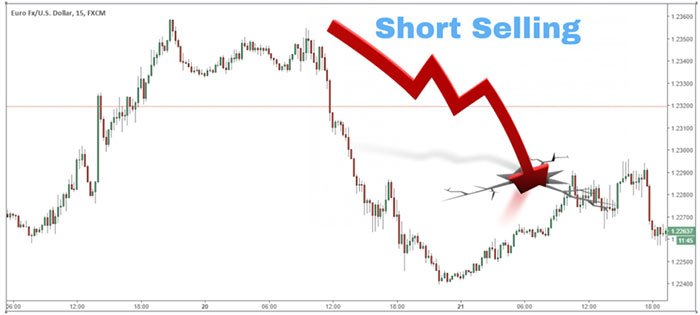
In a short position, a trader initiates a trade by selling a currency pair in anticipation of a price drop. If the price of the currency pair declines as expected, the trader can close the position by performing a buy action. This buy action can be done by either manually closing the position, or it can be done automatically with a preset like a take profit order. A profitable short position is typically closed at a lower price than when it was opened.
To better understand short selling, let’s first examine what happens when a long (buy) trade is placed. If you buy the EUR/USD currency pair, you actually buy the euro (the base currency) and simultaneously sell the U.S. dollar (the quote currency).
If the price moves higher after you’ve opened the trade, you can close this long (buy) position by selling the pair at a higher price. In this case, you will have made a profit.
With a short (sell) trade, the process is the other way around. If you sell the EUR/USD, you are buying the U.S. dollar (the quote currency), and at the same time, you are selling the euro (base currency). If the price moves lower after you’ve opened your short trade, you can close this short (sell) position by buying back the pair at a lower price.
In this case, you will have made a profit. A short (sell) trade on the EUR/USD is exactly the same as a long (buy) trade on the USD/EUR because the euro is sold while the U.S. dollar is bought.
However, on your Forex trading platform, this currency pair is only quoted as the EUR/USD, which means that you cannot place a long (buy) trade on the USD/EUR. So, to buy the U.S. dollar against the euro, your only option is to enter a short (sell) trade on the EUR/USD.
By using only one form (e.g., the EUR/USD) to combine two currencies in a pair, the process of analysing and trading currencies is simplified and streamlined. If every pair had two forms, traders would have to deal with different price quotes, pip value calculations, and charts.
For example, if the EUR/USD traded at 1.11111 dollars per euro, the USD/EUR would be quoted at 0.90000 euro per dollar.
Handy tip: Any trade action (buy or sell) is focussed on the base currency of a currency pair. The base currency is the first currency in any pair. For example, if you open a long (buy) trade on the EUR/USD, you are buying the euro, the first currency in this pair. If you open a short (sell) position on the EUR/USD, you are selling the euro. You can track the major pairs live here!
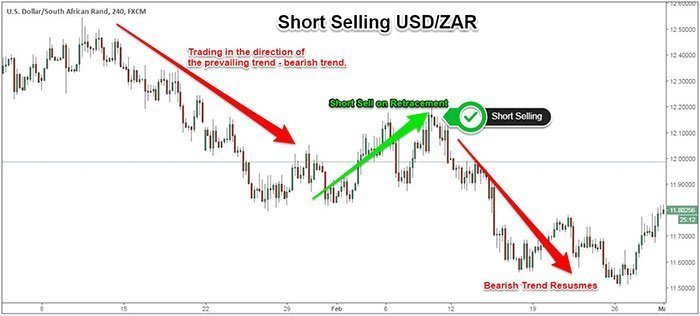
This example shows a bearish trend on the USD/ZAR currency pair. After a decent move lower, a short entry is taken as the price retraces against the predominant downtrend. Soon after the short trade is placed, the bearish trend resumes, and the short position moves deep into profit.
A short (sell) trade which is executed with a market order will be filled at the best (highest) bid price which is available at that moment. When a short trade is liquidated, it is closed at the lowest ask price available at that moment.
Unlike a short stock CFD trade, which theoretically carries unlimited risk, short selling a currency pair carries the same risk as buying it. The mechanics of long and short currency trades are the same. The only difference is direction: a short position will profit when the price declines, while a long position profits when the price moves higher.
Explore more resources that fellow traders find helpful! Check out these other guides to enhance your forex trading knowledge and skills. Whether you’re searching for the best brokers, educational material, or something more specific, we’ve got you covered:

Discover how Forex Trading works with our essential guide. Understand key terminology with examples and learn how to make your first successful trade.

We’ve tested hundreds of Forex brokers to find the safest, low-cost, and reliable brokers. Compare fees, and features—trade smarter with expert insights!

Explore the best Forex brokers for beginners, with user-friendly platforms, educational resources, and demo accounts.
Partner Manager and Financial Writer
Head of Content
Financial Writer