






Page Navigation


Select a different country or region to view content tailored to your location.


Alison Heyerdahl is the Head of Content at FxScouts, a Chartered Market Technician (CMT), and an experienced trader, as well as a financial writer with extensive expertise in Forex trading, broker analysis, and market research. She has reviewed 100+ brokers, publishes weekly YouTube trading videos, and co-hosts the “Let’s Talk Forex” podcast.


A trading plan will help you decide how Forex trading fits into your life. It will:
Your trading plan will define you as a trader. Developing a trading plan will allow you to think about what kind of trader you are and what that trader does differently. Different types of traders will rely more on one set of tools than another, trade at different times of the day, and hold trades for longer periods.
If you will excuse the analogy, this is similar to when a chef starts their cooking career. Before they can choose their recipes, they first need to understand what a chef's lifestyle is like and the recipes their chosen cuisine will dictate.
If you plan to generate an income from trading, creating a trading plan is the first step before making your first trade.
Trader profiles are very different and will dictate what type of trader you will become.
Each trader profile is different, with a different set of goals, risk aversion, and time commitment. While each of these traders will make trades on the market, what distinguishes them most is the length of time they leave their trades open.
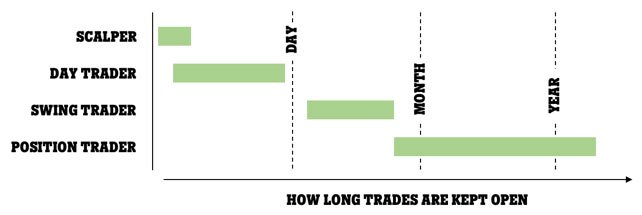
The Scalper: Scalping is a high-risk, high-reward trading strategy used by experts. The trading day is full of volatile periods, which requires scalpers to constantly monitor the charts for a good time to exit the trade. It is very fast-paced trading, with many small trades opening and closing all the time. Scalpers usually trade the openings of major markets.
The Day Trader: Day trading is slightly less risky than scalping and ideal for those who like to see their profit at the end of every day. This strategy is not for newcomers or traders who hope to leave their trades unattended while at work. This option is also good for traders who can not trade every day of the week but can still commit a full day to their trading.
The Swing Trader: Swing trading is a better setup for the beginner trader. Progress will be visible in your account over a period of a couple of days. This is an opportunity for a trader to set up fewer but better trades, which suits a trader still learning. If you are making longer trades and hoping to make a profit from swings in the market, make sure you have a well-funded account so you don’t get a margin call by your broker at a time when closing your trade could mean a loss on your account.
The Position Trader: Position trading is ideal for those with limited time and for those who spend long hours commuting that can be used for research. The downside of position trading is that much of the time, your capital will be locked in trades, limiting your ability to jump on explosive trends to make a quick profit.
Every trader will trade preferred currency pairs, which will dictate the markets and thus the time of day they will trade. In order to make money from Forex trading, prices need to be volatile. The market opens, and the major sessions create the volatility needed to find profitable trading opportunities.
The Forex Market is open throughout the five-day work week, so it is important to match your trading plan with the markets that are open. The most common period to trade is between 9 am and 5 pm GMT as this gives traders the opportunity to trade the close of the Tokyo session, the open of the London session and the open of the New York session.

Developing positive habits in Forex trading is important, as it puts the trader in the right frame of mind. Successful trading is all about repeating the same profitable techniques without emotions getting in the way of a process.
Your trading plan will define the rules by which you trade. This will include when to enter and exit trades, which timeframes to trade, whether to chase the market and how to establish your appetite for risk. Articles on strategy can be found in our Forex education section, but perhaps best to start with some Forex trading tips and strategy.
Risk management is the cornerstone of a successful trading plan. While it has a lot to do with the strategy you trade with, it also involves correctly assessing position size and the risk-to-reward ratio. Risk management can be divided into three parts.
Fine-tuning your trading plan is key. This includes backtesting your strategy and keeping records so you can track trading performance over time. Use this to adjust your strategy when necessary, as this adjustment is vital to continually profit from constantly changing markets.
Revisit your trading plan every 3-6 months, depending on the amount of time you have been able to set aside for trading. If you feel that you are more experienced you might want to start trading on shorter time periods or expand the range of currency pairs that you are trading. Regardless of whether you update your plan or not, it would help if you continually revisited it to ensure that your results align with your expectations.
Explore more resources that fellow traders find helpful! Check out these other guides to enhance your forex trading knowledge and skills. Whether you’re searching for the best brokers, educational material, or something more specific, we’ve got you covered:

Discover how Forex Trading works with our essential guide. Understand key terminology with examples and learn how to make your first successful trade.

We’ve tested hundreds of Forex brokers to find the safest, low-cost, and reliable brokers. Compare fees, and features—trade smarter with expert insights!

Explore the best Forex brokers for beginners, with user-friendly platforms, educational resources, and demo accounts.
Partner Manager and Financial Writer
Head of Content
Financial Writer